
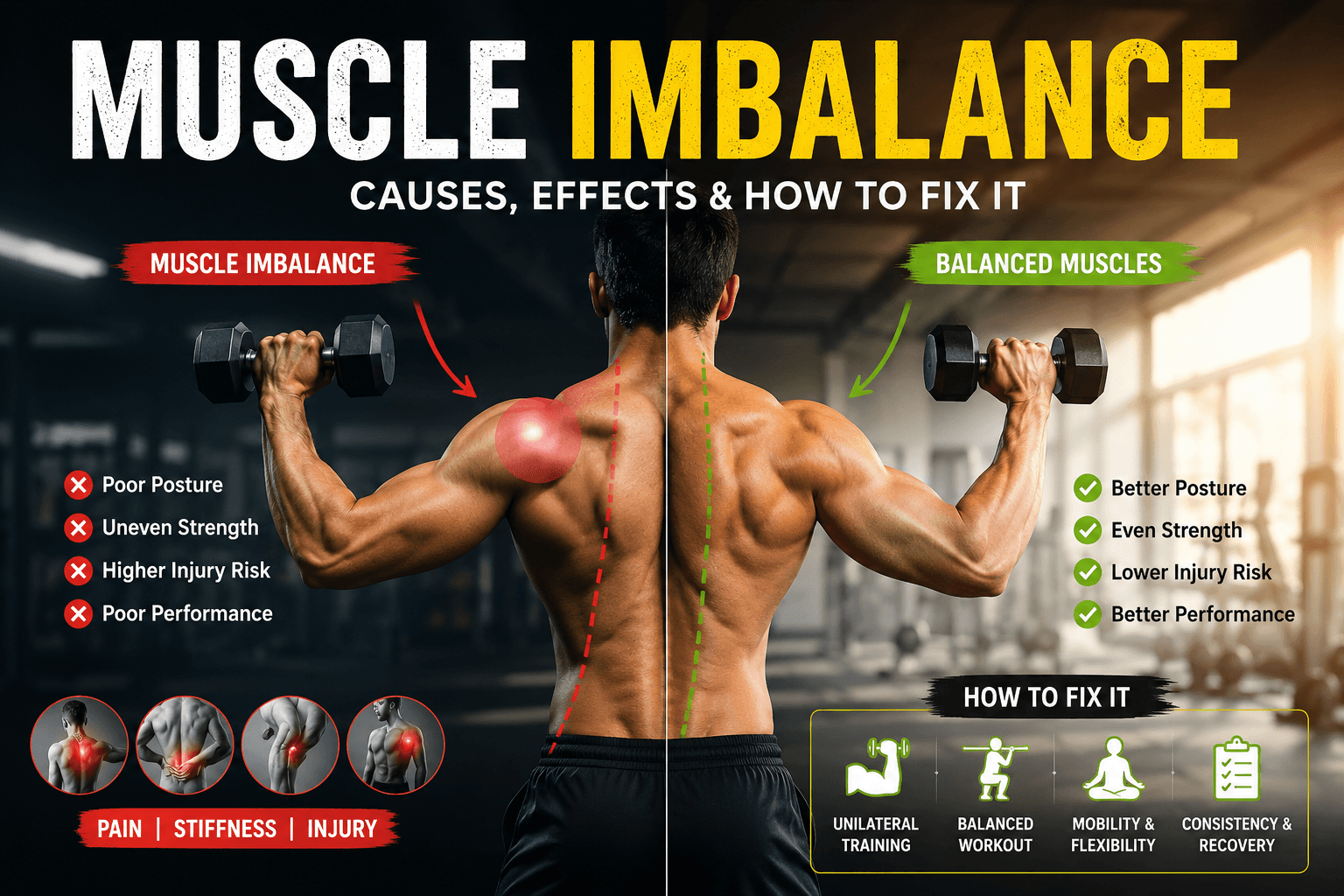
Have you ever noticed that one arm feels stronger than the other? Or maybe one leg does more work when you perform squats or lunges. You may also notice that one shoulder looks slightly higher than the other.
These differences can sometimes be a sign of muscle imbalance.
Muscle imbalance is common among beginners, regular gym-goers, athletes, and even people who do not exercise regularly. It can develop because of poor posture, incorrect exercise technique, previous injuries, daily habits, or simply using one side of the body more than the other.
A small difference between the two sides of your body is completely normal. However, a significant imbalance can affect your exercise performance, posture, movement, and potentially increase stress on certain joints and muscles.
The good news is that most muscle imbalances can be improved with proper training, better movement patterns, and consistency.
What Is Muscle Imbalance?
Muscle imbalance occurs when one muscle or muscle group is significantly stronger, weaker, tighter, or less active than another.
For example, your right biceps may be stronger than your left biceps. You might naturally use your right arm more when lifting weights, carrying objects, or performing daily activities.
Muscle imbalance does not only happen between the left and right sides of the body. It can also happen between opposing muscle groups.
For example:
- Chest muscles may be much stronger than upper-back muscles.
- Quadriceps may be stronger than hamstrings.
- Hip flexors may be tight while the glutes are weak.
- Core muscles may be weaker compared with the muscles around the lower back.
These differences can change the way your body moves during exercise.
Common Causes of Muscle Imbalance
There are several reasons why muscle imbalance develops. Understanding the cause is important because simply training the weaker muscle may not always solve the problem.
1. Using One Side More Often
Most people naturally have a dominant side. You may use your right hand for writing, carrying bags, opening doors, or performing other daily tasks.
Over time, repeated use can make one side stronger or more coordinated than the other.
2. Poor Exercise Technique
Incorrect form is another common reason for muscle imbalance.
For example, during a squat, you may unknowingly shift more weight toward one leg. During a bench press, one arm may push harder than the other.
If you repeat this pattern for months, your body can become accustomed to compensating with the stronger side.
3. Previous Injuries
After an injury, people often avoid putting pressure on the affected area. Even after the injury has healed, the body may continue using a different movement pattern.
For example, someone recovering from a knee injury may unconsciously put more weight on the opposite leg.
4. Poor Posture
Sitting at a desk for several hours every day can affect muscle balance.
A forward-head position, rounded shoulders, or prolonged sitting can contribute to weakness or tightness in different muscle groups.
5. Training Only the Muscles You Can See
Some gym-goers focus heavily on chest, arms, and shoulders because these muscles are visible in the mirror.
However, neglecting the back, rear shoulders, hamstrings, glutes, and core can create strength differences between muscle groups.
A balanced workout should train the entire body.
Signs You May Have a Muscle Imbalance
Muscle imbalance is not always obvious. However, there are several signs that may indicate a problem.
Uneven Strength
If you can perform 12 repetitions with one arm but struggle to complete the same number with the other, there may be a strength difference.
Uneven Muscle Size
You may notice that one biceps, shoulder, calf, or thigh appears larger than the other.
Some natural asymmetry is normal, so appearance alone does not necessarily mean you have a serious imbalance.
Poor Exercise Form
If your body consistently shifts to one side during squats, lunges, push-ups, or presses, it may indicate that one side is doing more work.
Reduced Range of Motion
One side may feel tighter or less flexible than the other.
For example, you may be able to raise one arm overhead easily while the other feels restricted.
Frequent Muscle Tightness
Constant tightness in one area can sometimes occur because another muscle is not doing enough of its normal job.
Difficulty Maintaining Balance
If one leg is significantly stronger or more stable than the other, exercises such as single-leg squats or lunges may feel very different on each side.
How Does Muscle Imbalance Affect Your Workout?
Muscle imbalance can influence both performance and movement quality.
When one muscle is stronger, your body may compensate by allowing that side to perform more of the work. This can make exercises less efficient and may place additional stress on certain muscles or joints.
For example, imagine performing a barbell squat while unconsciously shifting toward your right leg. Your right leg may perform more work while the left side contributes less.
Similarly, during a bench press, if one arm consistently moves faster than the other, the stronger side may be taking more of the load.
This is why good technique is often more important than simply lifting heavier weights.
How to Fix Muscle Imbalance
The first step is identifying where the imbalance exists. Once you know the weaker or less mobile area, you can modify your training accordingly.
1. Use Unilateral Exercises
Unilateral exercises train one side of the body at a time.
Examples include:
- Dumbbell bench press
- Single-arm row
- Single-arm shoulder press
- Bulgarian split squat
- Walking lunges
- Single-leg Romanian deadlift
- Single-leg calf raises
These exercises can prevent your stronger side from taking over.
2. Start With Your Weaker Side
When performing unilateral exercises, start with the weaker side.
For example, if your left arm is weaker, perform your left-arm dumbbell curl first.
Then perform the same number of repetitions on your stronger side.
Avoid doing extra repetitions with the stronger side simply because you can.
3. Focus on Proper Form
Don’t rush through exercises just to increase the weight.
Use a controlled movement and pay attention to your posture.
If you cannot maintain proper form, reduce the weight and focus on performing the exercise correctly.
4. Train Your Entire Body
A balanced workout should include all major muscle groups.
Your training program should include exercises for:
- Chest
- Back
- Shoulders
- Arms
- Core
- Glutes
- Quadriceps
- Hamstrings
- Calves
Training only your favorite muscles can create strength differences over time.
5. Improve Mobility and Flexibility
Strength is only one part of movement quality.
If one muscle group is excessively tight, mobility exercises and stretching may help improve your movement.
For example, people who sit for long periods may benefit from working on hip and upper-body mobility.
6. Don’t Ignore Your Core
Your core plays an important role in stabilizing the body during many exercises.
Exercises such as planks, dead bugs, bird dogs, and controlled carries can help develop core stability.
A stronger and more stable core can make it easier to maintain proper body position during compound exercises.
Can Muscle Imbalance Be Prevented?
You cannot completely eliminate natural differences between the two sides of your body. Almost everyone has a dominant hand or leg.
However, you can reduce excessive imbalances by following some simple habits.
Train both sides equally, use proper exercise technique, include unilateral exercises in your routine, and avoid constantly relying on your stronger side.
It is also important to increase weights gradually rather than trying to lift more than your body can properly control.
If you spend many hours sitting, take regular movement breaks and pay attention to your posture.
When Should You Get Professional Help?
Not every muscle imbalance requires medical treatment.
However, if you have persistent pain, significant weakness, numbness, swelling, restricted movement, or an imbalance that developed after an injury, it is better to consult a qualified healthcare professional or physical therapist.
A professional can assess your movement and identify whether the problem is related to muscle strength, flexibility, mobility, technique, or another underlying issue.
Final Thoughts
Muscle imbalance is common, and having a small difference between the two sides of your body is not necessarily a problem.
The bigger concern is when an imbalance becomes significant enough to affect your movement, exercise technique, strength, or comfort.
The best approach is not to simply train the weaker muscle as hard as possible. Instead, focus on balanced training, proper technique, unilateral exercises, mobility, and consistent progress.
Remember, the goal of strength training is not just to build bigger muscles. It is also to develop a body that can move efficiently, remain stable, and perform everyday activities and workouts with good control.
If you notice that one side is consistently doing more work during your exercises, don’t ignore it. Slow down, check your technique, reduce the weight if necessary, and work toward better balance.
A stronger body is not only about how much you can lift—it is also about how well you can move.
Kapil Kumar
Founder & Fitness Trainer – FITLIS
- 🏋️ 9+ years of fitness coaching
- 💪 Specializes in weight loss and muscle building
- 📺 YouTube: @fitlisfitness
- Instagram: @kapilkumar_79
- Facebook: @kapilkumar.7790
- GYM App: @fitlisgym
- 🌐 https://fitlis.in/about