
Is One Day of Rest Compulsory During Workouts?
When people start going to the gym, they often believe that training every single day will help them build muscle faster, lose fat quicker, and become stronger in less time. While consistency is extremely important, your body also needs time to recover. Training hard without enough recovery can actually slow down your progress rather than improve it.
So, is one day of rest compulsory during workouts? The simple answer is not necessarily for everyone, but regular rest and recovery are essential. Your body needs recovery time depending on your workout intensity, training experience, sleep, nutrition, age, and overall lifestyle.
A rest day does not mean you are being lazy. It is part of your fitness program.

Table of Contents
What Happens to Your Body During a Workout?
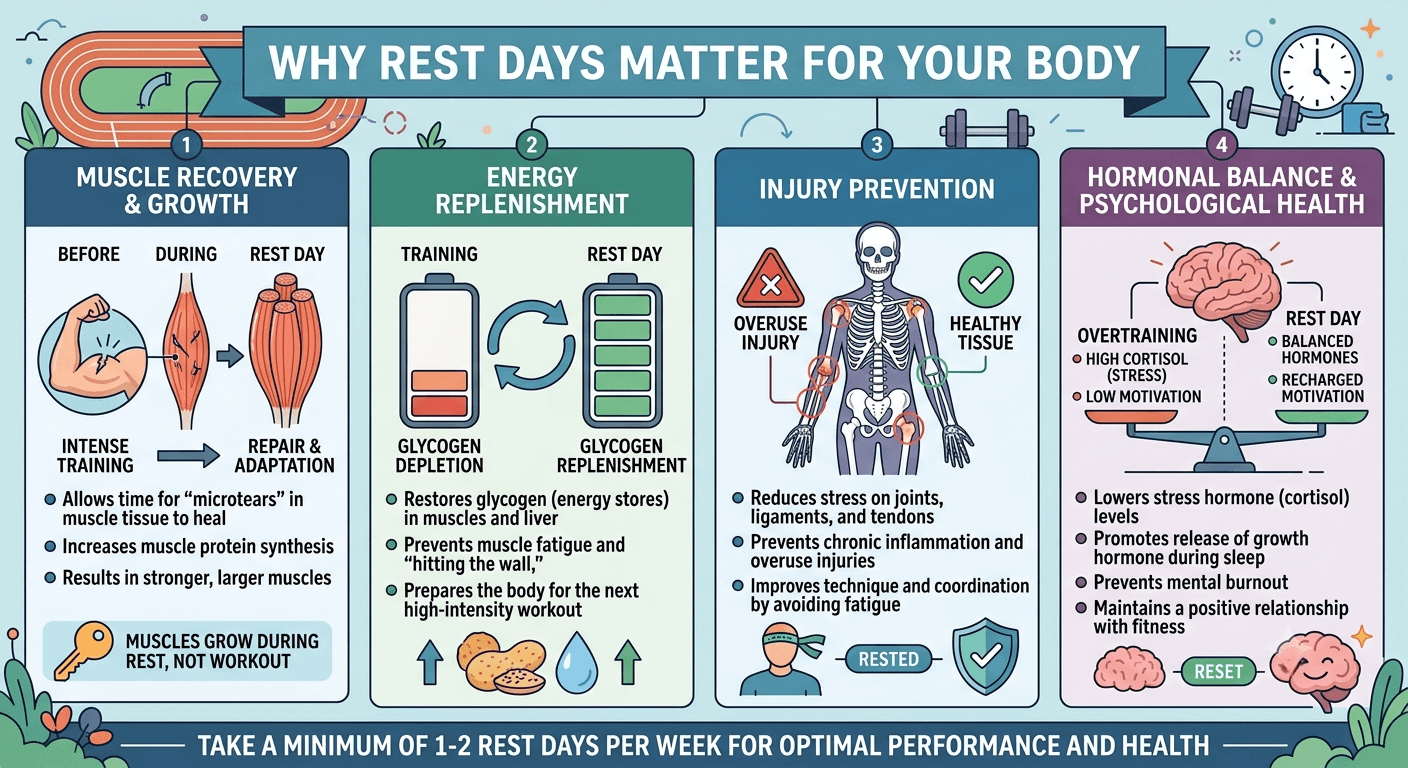
When you perform strength training, your muscles are placed under stress. Small amounts of muscle damage can occur during intense resistance training. Your body then begins repairing and adapting those muscles during recovery.
This process helps your muscles become stronger and better prepared for your next workout.
Your muscles are not actually growing because you are lifting weights at that exact moment. The workout provides the stimulus. Recovery, nutrition, and sleep help your body adapt to that stimulus.
This is why training harder is not always the same as making faster progress.
If you constantly train without giving your body enough time to recover, you may feel tired, weak, sore, or unmotivated.
Why Do You Need a Rest Day?
A rest day gives your body an opportunity to recover from the physical stress of training.
During rest, your muscles can repair themselves, your energy levels can improve, and your nervous system gets a break from repeated training demands.
For someone doing intense weight training five or six days a week, taking at least one complete rest day can be a practical way to manage recovery.
However, the exact number of rest days depends on the person.
A beginner may need more recovery than an experienced athlete. Someone doing heavy leg training may need more recovery than someone doing a light workout.
Rest Helps Muscle Growth
If your goal is to build muscle, recovery is just as important as your workout.
Resistance training creates a stimulus that tells your body that it needs to adapt. Your body needs adequate protein, calories, sleep, and recovery to support that adaptation.
If you train the same muscles intensely every day without sufficient recovery, you may not give them enough time to recover before placing them under stress again.
This is one reason workout programs usually divide muscle groups across different days.
For example:
- Monday – Chest and triceps
- Tuesday – Back and biceps
- Wednesday – Legs
- Thursday – Shoulders
- Friday – Chest and arms
- Saturday – Legs or full-body training
- Sunday – Rest
This type of schedule allows different muscle groups to recover while you continue being active.
Rest Days Can Improve Your Performance
Imagine training legs heavily today and then trying to perform another intense leg workout tomorrow while your muscles are still tired.
You may notice that your strength is lower, your technique is worse, or you cannot perform the same number of repetitions.
Recovery can help you return to your next workout with better energy and performance.
For strength training, performance matters. If fatigue continues accumulating, it can become difficult to progressively increase your weights, repetitions, or training quality.
Sometimes taking one step back and recovering can help you take two steps forward.
Rest Is Also Important for Your Joints and Connective Tissues
Muscles are not the only structures involved in exercise.
Your joints, tendons, ligaments, and other connective tissues also experience stress during training.
Your muscles may feel ready before other tissues have completely recovered, particularly when you repeatedly perform heavy movements.
This is another reason why training intelligently is better than simply training as much as possible.
Good technique, appropriate exercise selection, sensible progression, and adequate recovery can all help you maintain a sustainable training routine.
Does Rest Mean You Should Stay in Bed All Day?
Not at all.
There is a difference between a complete rest day and an active recovery day.
On a complete rest day, you might simply take a break from structured exercise.
On an active recovery day, you could do light activities such as:
- Walking
- Gentle stretching
- Mobility exercises
- Easy cycling
- Light recreational activity
The key is to keep the activity easy enough that it does not create significant additional fatigue.
If you are extremely sore or exhausted, a complete rest day may be more appropriate.
What About People Who Want to Lose Weight?
Some people believe they must exercise every day to lose fat.
That is not necessarily true.
Fat loss primarily depends on maintaining an appropriate calorie deficit over time. Exercise can help increase energy expenditure and improve fitness, but doing more and more workouts is not automatically better.
If exercising every day makes you extremely tired, affects your sleep, increases hunger significantly, or reduces the quality of your workouts, it may not be the best strategy.
A sustainable routine that combines exercise, nutrition, sleep, and recovery is usually more practical.
You can lose fat while still having rest days.
Signs That You May Need More Recovery
Your body often gives you signals when your training load is too high or your recovery is insufficient.
Some possible signs include:
1. Constant muscle soreness
Normal soreness can happen after training, especially when starting a new program. But persistent or severe soreness may indicate that you need more recovery.
2. Declining strength
If your normal weights suddenly feel much heavier for several workouts, accumulated fatigue may be contributing.
3. Constant tiredness
Feeling exhausted throughout the day despite getting enough sleep can be a sign that your overall workload needs to be reviewed.
4. Poor sleep
Hard training combined with insufficient recovery can sometimes negatively affect sleep.
5. Lack of motivation
If you normally enjoy training but suddenly feel mentally exhausted every time you enter the gym, your body may need a break.
6. Persistent aches or pain
Normal post-workout soreness is different from sharp, persistent, or worsening pain. Pain should not simply be ignored in the belief that more training will make it disappear.
How Many Rest Days Should You Take?
There is no universal rule that says everyone must rest exactly one day every week.
Your ideal recovery schedule depends on your training program and lifestyle.
For many beginners, three to five training sessions per week with one or more rest days can be a good starting point.
More experienced lifters may train more frequently, but their programs often control intensity and volume carefully.
For example, you could train six days per week while rotating muscle groups and keeping some sessions lighter. Another person may make better progress training four days per week.
The goal is not to find the maximum number of days you can survive in the gym.
The goal is to find the amount of training that you can recover from and consistently improve with.

Sleep Is Another Form of Recovery
A rest day alone cannot compensate for poor sleep.
If you are training hard but sleeping only a few hours every night, your recovery may suffer.
Most adults generally benefit from around 7–9 hours of sleep per night, although individual needs vary.
Sleep supports physical recovery, energy, concentration, and training performance.
So think of recovery as a complete system:
Workout + Nutrition + Sleep + Rest = Better Recovery
Ignoring any one of these areas can make your fitness journey more difficult.
You Don’t Need to Feel Guilty About Missing a Workout
Many fitness enthusiasts feel guilty when they take a day off.
They think, “If I don’t train today, I will lose my progress.”
One rest day will not destroy your gains.
In fact, strategically taking rest can help you return to training with better energy and focus.
Fitness is not about what you do for one day. It is about what you can consistently do for months and years.
Missing one workout is far less important than maintaining a healthy training routine over the long term.
Rest Day Does Not Mean Losing Discipline
Discipline is not about doing the maximum amount of exercise every day.
Real discipline means understanding when to push and when to recover.
A good athlete knows how to train hard, but also knows when the body needs recovery.
Your workout should challenge you, but it should also be sustainable.
If you continuously push beyond your ability to recover, eventually your performance can suffer.
The Bottom Line
So, is one day of rest compulsory during workouts?
Not necessarily. But regular recovery is compulsory if you want long-term progress.
Some people may benefit from one complete rest day every week. Others may need two or more depending on their training intensity, lifestyle, age, fitness level, and recovery ability. Some experienced athletes can train daily because their programs carefully manage intensity, volume, and muscle-group recovery.
What matters most is listening to your body and following a well-designed training program.
Remember, your workout is the stimulus, but recovery is where your body adapts.
Don’t think of a rest day as a wasted day. Think of it as an important part of your fitness program.
Train hard. Eat well. Sleep properly. Recover properly.
And then come back stronger for your next workout.
Kapil Kumar
Founder & Fitness Trainer – FITLIS
- 🏋️ 9+ years of fitness coaching
- 💪 Specializes in weight loss and muscle building
- 📺 YouTube: @fitlisfitness
- Instagram: @kapilkumar_79
- Facebook: @kapilkumar.7790
- GYM App: @fitlisgym
- 🌐 https://fitlis.in/about