
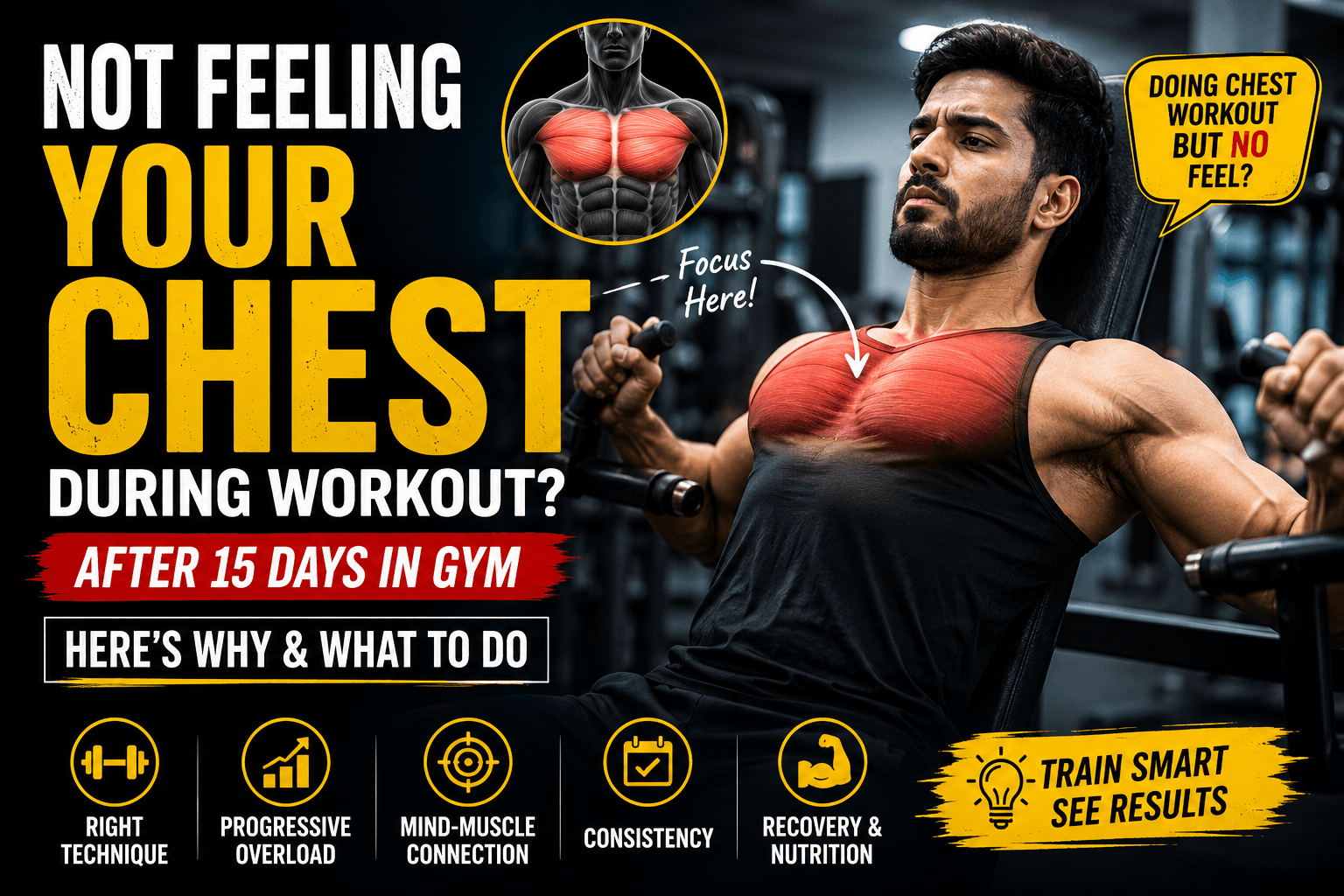
A common question I hear from new gym members is:
“I have been coming to the gym for 15 days, but when I do chest exercises, I don’t feel anything in my chest. Am I doing something wrong?”
This is a very normal concern, especially for beginners.
When someone starts training, they often expect to immediately feel a strong burn, pump, or soreness in the target muscle. If they don’t feel their chest during a workout, they may think the exercise isn’t working.
But the reality is a little different.
Not feeling a strong sensation in your chest does not automatically mean that your chest muscles are not working.
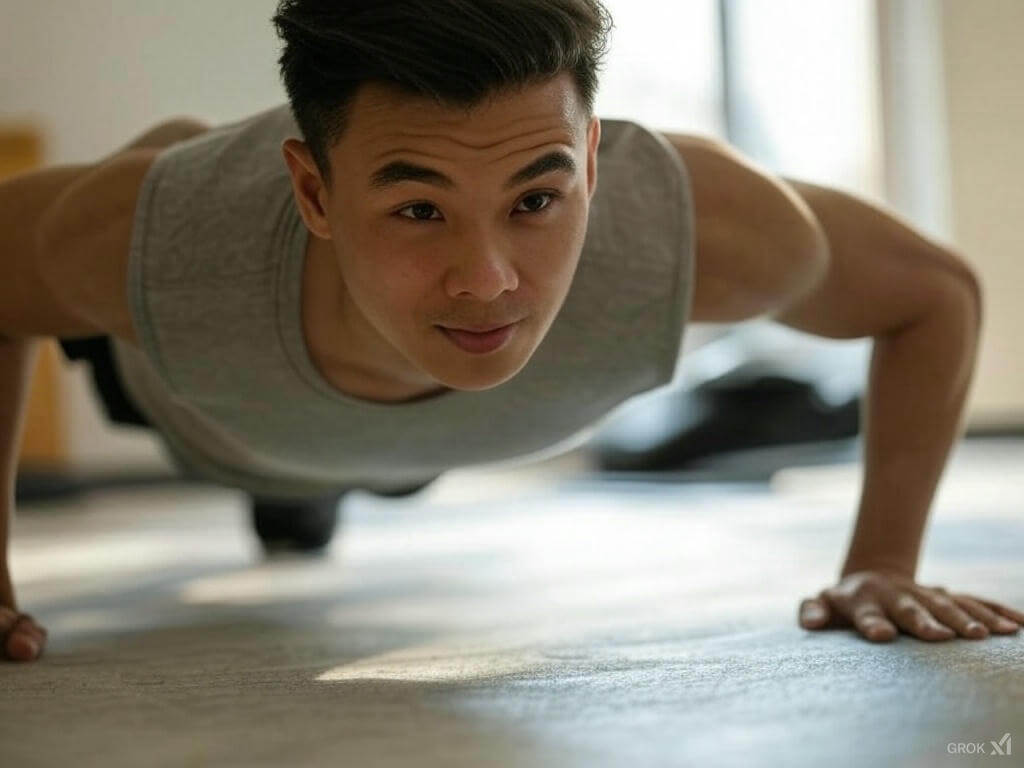
Your chest can be working even when you don’t experience a dramatic pump or burning sensation. At the same time, if you consistently feel an exercise mainly in your shoulders or triceps, your technique may need some adjustment.
Table of Contents
Let’s understand why this happens and what you can do about it.
1. Fifteen Days Is Still the Beginning
The first thing I tell a new client is simple: give your body time to learn.
If you have only been training for 15 days, you are still in the early stage of your fitness journey.
Your body is learning how to coordinate different muscles during exercises. Your nervous system is adapting to new movements, and you are still developing basic exercise technique.
For example, when you perform a bench press, several muscles work together, including the chest, shoulders, and triceps.
A beginner may not immediately understand how to properly use the chest during the movement.
This doesn’t mean the workout is useless.
With regular practice, your technique and body awareness can improve.
2. You Don’t Need to Feel Soreness for Growth
One of the biggest misconceptions in the gym is:
“If I am not sore the next day, my workout didn’t work.”
This is not true.
Muscle soreness, especially when starting a new exercise program, can happen because your muscles are being exposed to unfamiliar stress. However, soreness is not a reliable measurement of muscle growth.
You can have an effective workout without experiencing significant soreness.
Similarly, you can become extremely sore after a workout without necessarily having a better muscle-building session.
So don’t judge your chest workout only by how sore your chest feels the next morning.
Instead, pay attention to your technique, training consistency, progression, recovery, and overall performance.
3. You May Be Lifting Too Much Weight
This is one of the most common reasons beginners don’t feel the target muscle properly.
Suppose you are doing a bench press with more weight than you can control.
Your body may naturally try to complete the movement by using other muscles and changing your technique.
Your shoulders and triceps may take over more of the work, while you lose control of the chest movement.
Instead of asking:
“How much weight can I lift?”
Ask:
“Can I control this weight with good technique?”
Reducing the weight slightly can sometimes make the exercise feel much better.
A lighter weight performed with controlled movement can be more useful than a heavier weight performed with poor form.
4. Your Technique May Need Improvement
Chest exercises require proper positioning.
During a bench press, for example, your body position, grip, elbow movement, range of motion, and control all influence how the exercise feels.
If your shoulders are moving excessively or your elbows are positioned incorrectly, you may feel more stress in your shoulders.
This is why beginners should spend time learning the movement instead of immediately trying to lift heavy weights.
Ask a qualified trainer to watch your technique.
Sometimes a small adjustment can make a significant difference.
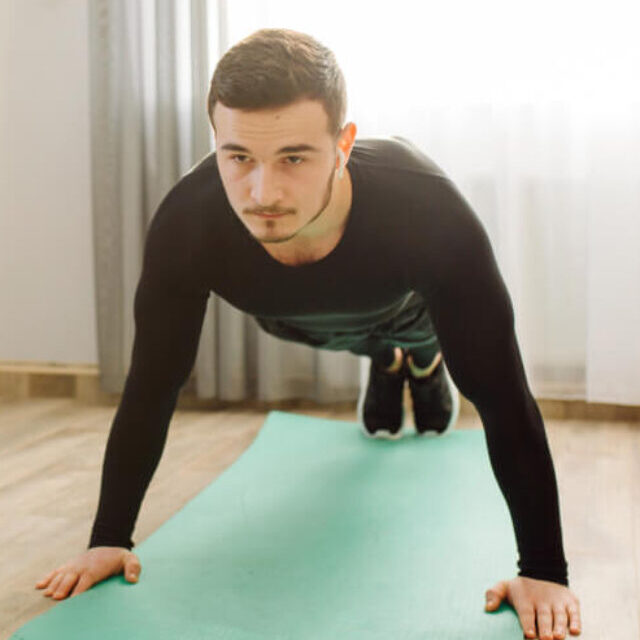
5. Focus on the Movement, Not Just the Weight
Many beginners think about completing the required number of repetitions as quickly as possible.
For example:
“10 reps done. Next set.”
But resistance training is not simply about moving a weight from one position to another.
Try to understand what the exercise is supposed to do.
During a chest press, think about bringing your upper arms toward the center of your body rather than simply pushing the weight away from you.
During a chest fly, focus on controlling the movement and bringing the arms together without aggressively forcing the joints.
This type of awareness can help improve what is commonly called the mind-muscle connection.
However, don’t overthink it. Good technique should come first.
6. Slow Down Your Repetitions
Another common problem is performing repetitions too quickly.
If you lower the weight very fast and immediately push it back up, you may have less control over the movement.
Try using a controlled tempo.
For example:
- Lower the weight under control.
- Pause briefly if appropriate.
- Press smoothly.
- Avoid bouncing or using momentum.
- Maintain good positioning throughout the repetition.
You don’t need to make every repetition extremely slow.
The goal is simply to remain in control instead of allowing the weight to control you.
7. Use a Full, Comfortable Range of Motion
Range of motion also matters.
If you perform very short repetitions, you may not be challenging the muscle through the intended movement.
However, “full range of motion” doesn’t mean forcing your joints into uncomfortable positions.
Your range should be appropriate for your body, mobility, exercise, and experience level.
For beginners, learning a comfortable and controlled range of motion is more important than trying to copy the deepest movement someone else is doing.
Quality repetitions are more valuable than simply chasing a larger range.
8. Your Chest Is Not the Only Muscle Working
This is important to understand.
Most pressing exercises are compound movements.
That means several muscles contribute to the exercise.
During a bench press, your chest isn’t working alone. Your triceps and shoulders also contribute.
Therefore, feeling some work in your triceps or shoulders doesn’t automatically mean your chest isn’t working.
The goal isn’t necessarily to eliminate every sensation from other muscles.
Instead, you want the exercise to be performed with appropriate technique so that the intended muscles are contributing effectively.
9. Try Starting With a Chest Isolation Exercise
Some beginners find it easier to understand their chest muscles when they perform an isolation movement before a compound press.
For example, a trainer may use a machine chest fly or cable fly early in the workout.
The purpose isn’t to completely fatigue the chest before pressing.
Instead, it can help a beginner understand the movement and develop better awareness of the chest.
After that, a pressing movement may feel different.
However, exercise order should depend on the individual’s goals and training program.
You don’t need to constantly change your workout just because you don’t feel a big pump.
10. Don’t Chase the Pump
The chest pump can feel satisfying.
After several sets, your chest may temporarily feel fuller or tighter because of increased blood flow and other physiological changes.
But the pump itself is not the goal.
A workout can be productive with or without a dramatic pump.
Some days you may feel an excellent pump.
Other days you may not.
Sleep, hydration, food intake, exercise selection, training volume, rest periods, and many other factors can influence how a workout feels.
Therefore, don’t assume that a workout was bad simply because you didn’t get a huge pump.
11. Focus on Progressive Overload
If your goal is to build muscle, one of the most important long-term concepts is progressive overload.
Over time, you want your muscles to gradually handle more training stress.
This could involve:
- Increasing weight gradually
- Performing more controlled repetitions
- Improving technique
- Increasing training volume when appropriate
- Improving range of motion
- Getting stronger at the same exercise
You don’t need to increase the weight every workout.
Especially during your first few weeks, learning proper technique can be a form of progress itself.
Your goal should be long-term improvement rather than trying to destroy your chest every session.
12. Give Your Body Enough Recovery
A new gym member sometimes thinks:
“If I don’t feel my chest, I should train chest again tomorrow.”
That’s not necessarily a good idea.
Muscles need recovery between challenging training sessions.
Your overall recovery is influenced by sleep, nutrition, hydration, stress, and training volume.
If you are constantly training the same muscle without enough recovery, more exercise isn’t automatically better.
A structured workout plan is usually more useful than randomly adding extra chest sessions.
13. When Should You Ask a Trainer for Help?
If you consistently feel pain, especially sharp or unusual pain, stop the exercise and get appropriate professional advice.
There is an important difference between muscle effort and pain.
A burning sensation from muscular fatigue can be different from sharp pain in the shoulder, chest, elbow, or other area.
If you repeatedly feel an exercise mainly in your shoulders or experience discomfort, ask a qualified fitness professional to check your technique and exercise selection.
Don’t try to “push through” unexplained pain simply because you think pain means the workout is effective.
A Simple Message for New Gym Members
If a client tells me:
“I’ve been coming for 15 days and I don’t feel my chest during chest workouts.”
I wouldn’t immediately say that the workout isn’t working.
Instead, I would check:
- Is the exercise technique correct?
- Is the weight appropriate?
- Is the range of motion controlled?
- Is the client rushing through repetitions?
- Are the shoulders taking over?
- Is the client getting enough recovery?
- Is the client expecting soreness or a pump as proof of progress?
These questions give us a much better picture.
Final Thoughts
Not feeling a strong sensation in your chest after 15 days of training is usually not a reason to panic.
Your body is still learning.
Don’t measure your progress only by soreness, pain, or the size of your pump. Instead, focus on learning proper technique, using manageable weights, controlling your repetitions, following a consistent training program, recovering properly, and gradually becoming stronger.
Building muscle takes time.
Your first few weeks in the gym are about learning the basics and creating good habits. As your technique improves, you may develop a better awareness of the muscles you are training.
Remember:
You don’t need to feel extreme pain to have a good workout.
You don’t need to be sore the next day to build muscle.
And you don’t need to lift extremely heavy weights to make progress.
Train consistently, focus on quality movement, and give your body enough time to adapt.
The results will come from what you do consistently over weeks and months—not from what you feel during one workout.
Kapil Kumar
Founder & Fitness Trainer – FITLIS
- 🏋️ 9+ years of fitness coaching
- 💪 Specializes in weight loss and muscle building
- 📺 YouTube: @fitlisfitness
- Instagram: @kapilkumar_79
- Facebook: @kapilkumar.7790
- GYM App: @fitlisgym
- 🌐 https://fitlis.in/about