
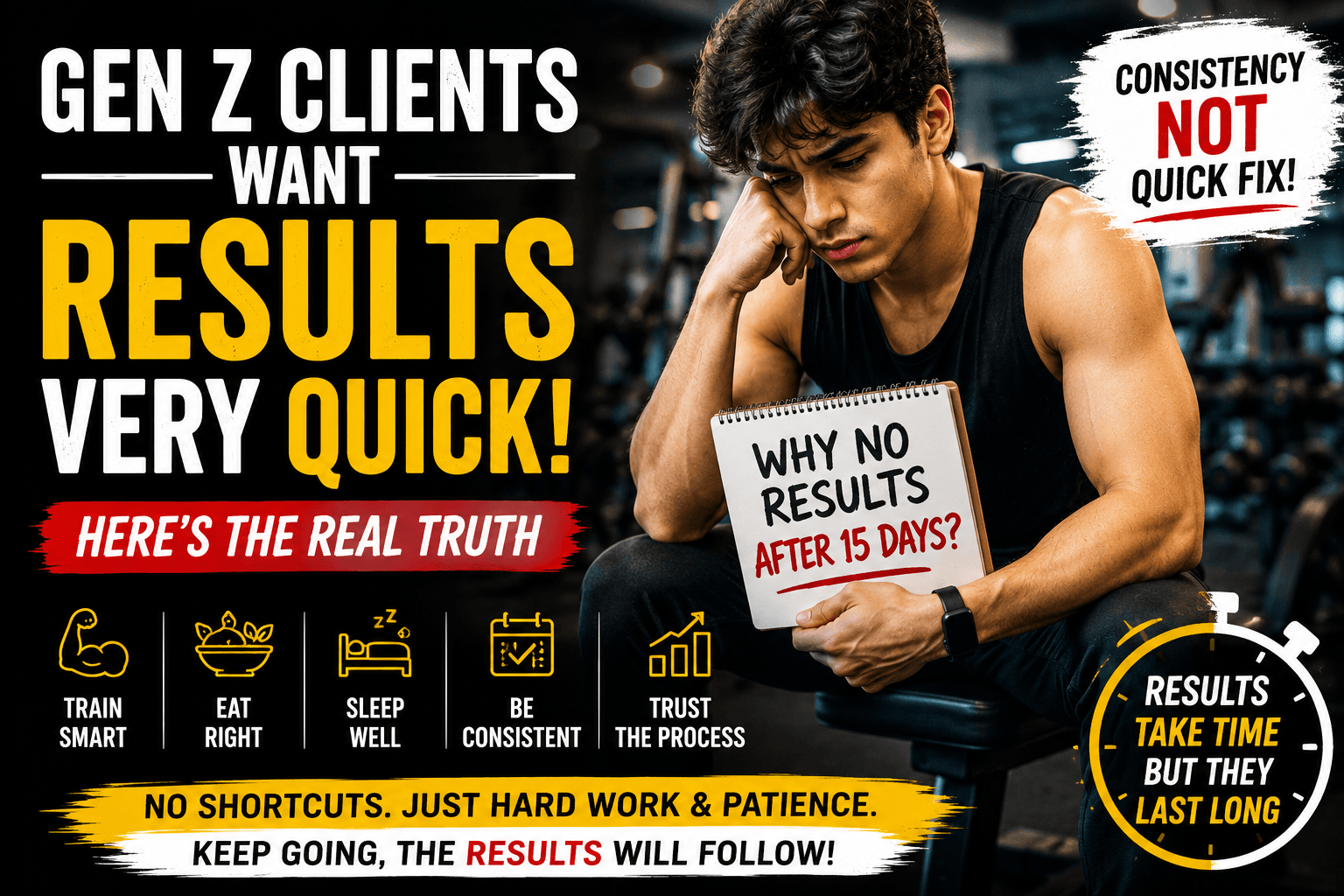
Walk into almost any gym today and you will notice something interesting.
Many young clients arrive with big goals. They want bigger muscles, visible abs, a lean body, better shoulders, a smaller waist, or a complete transformation. There is nothing wrong with having ambitious fitness goals.
The problem starts when they expect those results very quickly.
A new client may join the gym on Monday and, by the second or third week, ask:
“Why am I not seeing results yet?”
Some clients expect visible abs within a few weeks. Others want noticeable muscle gain in a month. Some compare their body with an influencer they saw on Instagram and wonder why their own transformation isn’t happening at the same speed.
As a fitness trainer, one of the most important things we can teach young clients is that fitness is not an instant-result business.
Your body doesn’t change because you want it to change quickly. It changes because you consistently give it the right training, nutrition, recovery, and time.
Social Media Has Changed Our Expectations
One major reason young people want quick results is social media.
Every day, we see transformation videos, fitness influencers, workout reels, before-and-after photos, and “30-day transformation” content.
A person may scroll through Instagram or YouTube and see someone who supposedly transformed their body in a few weeks.
The problem is that social media usually shows the highlight, not the entire journey.
You don’t see the person’s previous years of training.
You don’t see their diet every day.
You don’t see their sleep schedule.
You don’t see how many workouts they completed before the transformation video was recorded.
You also don’t know whether lighting, posing, muscle pump, dehydration, editing, or other factors changed the appearance of the body.
Young clients sometimes compare their day 15 with somebody else’s year 5.
That comparison is unfair.
The “I Want Results Now” Mindset
We live in an environment where many things happen instantly.
You can order food from your phone, watch almost any movie immediately, get answers from search engines, and communicate with someone on the other side of the world within seconds.
This can create an expectation that everything should work quickly.
But the human body doesn’t work like a smartphone app.
You cannot press a button and download muscle.
You cannot complete ten workouts and suddenly have a completely different body.
Fitness requires adaptation.
Your muscles, cardiovascular system, nervous system, movement patterns, and energy systems all need time to adapt to training.
That’s why consistency matters more than excitement.
The First Few Weeks Are About Learning
When someone joins a gym, they often think the first month should be about dramatic physical transformation.
Actually, the first few weeks are extremely important for another reason: learning.
A beginner has to learn how to squat properly.
They need to understand how to perform a chest press.
They need to learn how to adjust machines.
They need to understand repetitions, sets, rest periods, warm-ups, and exercise technique.
They also need to learn how their own body responds to training.
For a new client, being able to perform an exercise with better technique after three weeks is progress.
Being able to control the same weight better is progress.
Feeling more confident in the gym is progress.
Fitness progress is not always visible in the mirror.
Muscle Growth Takes Time
One of the most common expectations among young male clients is rapid muscle growth.
They may see a muscular influencer online and think:
“I want that body.”
That’s fine as a long-term goal.
But building significant muscle naturally requires consistent resistance training, adequate nutrition, sufficient protein, recovery, and time.
Your body needs repeated training stimulus before substantial changes become visible.
A beginner may experience some relatively quick improvements in strength because their nervous system is becoming more efficient at performing movements.
But that doesn’t mean they are going to gain a huge amount of muscle within a few weeks.
Instead of asking, “Why don’t I look muscular yet?”, ask:
“Am I getting stronger and performing my exercises better?”
That is a much healthier way to measure early progress.
Weight Loss Can Also Take Time
The same issue happens with clients who want to lose weight.
Someone may join the gym because they want to lose 10 or 15 kilograms.
After one week, they step on the weighing scale and become disappointed because the number hasn’t changed much.
But body weight can naturally fluctuate from day to day because of hydration, food intake, sodium, digestion, and other factors.
One weigh-in doesn’t tell the whole story.
A better approach is to look at trends over time.
Track body weight consistently under similar conditions, while also paying attention to waist measurements, fitness levels, strength, photos, clothing fit, and overall habits.
The goal is not to become obsessed with the weighing scale.
The goal is to build sustainable habits that can continue for months and years.
The Problem With Constantly Changing Workouts
When young clients don’t see quick results, some start changing everything.
Monday: one workout from Instagram.
Wednesday: another workout from YouTube.
Friday: a different influencer’s routine.
The following week, they completely change their diet.
This creates confusion.
Your body needs enough consistency to understand the training stimulus and for you to evaluate whether the program is working.
Changing exercises every few days because you haven’t seen a transformation yet is usually not the answer.
A good training program doesn’t need to be exciting every single day.
Sometimes the boring consistency is exactly what produces the exciting result later.
Stop Chasing the Perfect Workout
Another problem is the search for the “best” exercise.
Clients ask:
“Which exercise will give me abs fastest?”
“Which exercise will make my chest bigger quickly?”
“Which workout will burn the most fat?”
There are useful exercises and less useful exercises, but there is no magic movement that replaces consistency.
The best workout is often the one you can perform correctly and consistently.
A simple workout performed regularly for months can produce better results than a complicated program followed for two weeks.
Results Don’t Come From Exercise Alone
Young clients sometimes believe that joining a gym is enough.
They may train for one hour and then spend the rest of the day ignoring their nutrition and sleep.
Training is important, but it is only one part of the picture.
Your body also needs adequate nutrition and recovery.
If your goal is muscle growth, you need to support your body with sufficient energy and protein.
If your goal is fat loss, your overall calorie intake and eating habits matter.
Sleep is also important because recovery doesn’t stop when you leave the gym.
You don’t build your body only while lifting weights. Your body adapts during recovery as well.
Don’t Compare Your Body With Influencers
This is perhaps one of the most important lessons for today’s young gym members.
Social media can be motivating, but it can also create unrealistic expectations.
The person you see online may have different genetics, training history, lifestyle, nutrition, body composition, and goals.
Some fitness content is also carefully staged.
Different lighting can make muscles appear dramatically different.
A muscle pump can temporarily make someone look bigger.
A good pose can make the waist look smaller.
Editing can change the appearance even further.
So use social media for inspiration, but don’t use someone else’s body as a deadline for your own transformation.
What Should Gen Z Clients Focus On?
Instead of chasing instant results, focus on a few simple things.
Train consistently.
Don’t expect motivation to be present every day. Build a routine.
Learn proper technique.
Good form is more valuable than lifting a weight just to impress people.
Eat appropriately for your goal.
Don’t randomly follow extreme diets because someone online recommended them.
Get enough recovery.
Training hard every day isn’t automatically better.
Track your progress.
Record your workouts, weights, repetitions, measurements, and progress photos when appropriate.
Be patient.
This is probably the hardest one.
But patience is part of fitness.
Your Body Is Not an Overnight Project
A good trainer should not only teach exercises.
A good trainer should also teach clients how to think about fitness.
If a client learns to expect instant results, they may become frustrated and quit.
But if they understand that fitness is a long-term process, they are more likely to stay consistent.
Think about it this way:
You didn’t gain your current body in one week.
You shouldn’t expect to completely change it in one week either.
Every workout is one small step.
One workout may not make a visible difference.
Ten workouts may still produce only subtle changes.
But hundreds of consistent workouts over time can completely change your strength, fitness, confidence, and physique.
Final Thoughts
Gen Z clients are not wrong for wanting results quickly. They have grown up in a world where information, entertainment, communication, and services are available almost instantly.
But fitness is different.
Your body needs time to adapt.
Instead of asking “How quickly can I transform?”, start asking:
“How long can I stay consistent?”
That question changes everything.
Don’t judge your progress after just two weeks.
Don’t quit because your abs aren’t visible yet.
Don’t change your workout every few days because you saw a new routine online.
Don’t compare your beginning with someone else’s finished journey.
Show up.
Train properly.
Eat according to your goal.
Recover.
Track your progress.
And give yourself enough time.
The fastest way to get frustrated in fitness is to expect overnight results.
The better approach is to build habits that you can maintain for years.
Quick motivation may get you into the gym, but long-term consistency is what changes your body.
Kapil Kumar
Founder & Fitness Trainer – FITLIS
- 🏋️ 9+ years of fitness coaching
- 💪 Specializes in weight loss and muscle building
- 📺 YouTube: @fitlisfitness
- Instagram: @kapilkumar_79
- Facebook: @kapilkumar.7790
- GYM App: @fitlisgym
- 🌐 https://fitlis.in/about