
Protein is one of the most important nutrients in our diet. Whether your goal is to build muscle, lose fat, improve strength, recover from workouts, or simply maintain a healthy body, getting enough protein matters.
But one question comes up again and again, especially among people who have recently started going to the gym:
“How much protein do I actually need every day?”
You may have heard numbers like 50 grams, 100 grams, 150 grams, or even 200 grams. But protein requirements are not the same for everyone. Your body weight, activity level, fitness goals, age, and overall diet can all influence how much protein you need.
The good news is that calculating your protein requirement doesn’t have to be complicated.
In this guide, we’ll explain a simple way to calculate your daily protein intake and how to divide it between your meals.
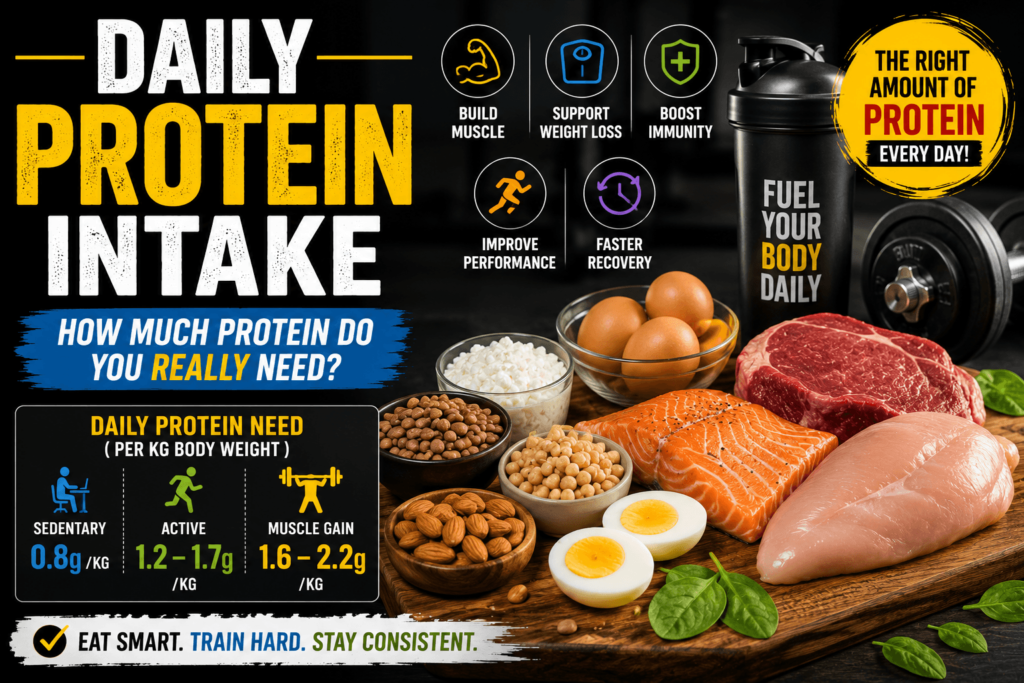
Table of Contents
Why Does Your Body Need Protein?
Protein is made up of amino acids, which your body uses for many important functions.
Protein helps your body build and maintain muscles, but its role goes far beyond muscle growth. Your body also uses protein to support tissues, enzymes, hormones, immune function, and many other biological processes.
If you exercise regularly, protein becomes particularly important because training places stress on your muscles. Adequate protein intake helps support muscle repair and adaptation after exercise.
This doesn’t mean that eating huge amounts of protein will automatically make you muscular.
Your overall diet, training program, sleep, recovery, and calorie intake all matter.
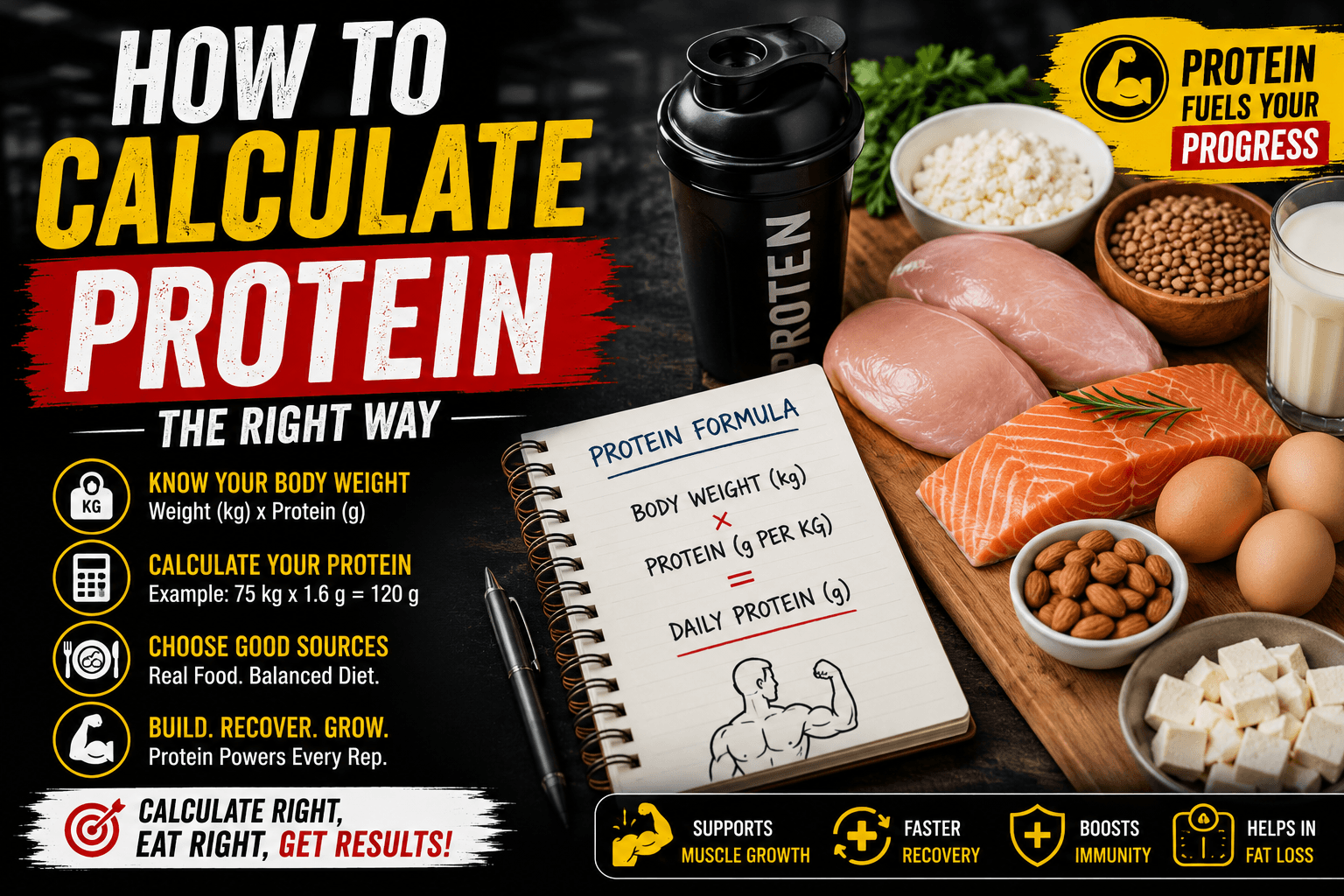
The Simplest Way to Calculate Protein
For most people who exercise regularly, a practical starting point is to calculate protein based on body weight.
A commonly used range for active adults is approximately:
1.2–2.0 grams of protein per kilogram of body weight per day.
People focused on building or maintaining muscle while training regularly may often choose a target around the middle or upper part of that range.
For example, if you weigh 70 kg:
- 70 × 1.2 = 84 grams
- 70 × 1.6 = 112 grams
- 70 × 2.0 = 140 grams
So, depending on your activity and goals, a reasonable daily target might fall somewhere around 84–140 grams.
You don’t necessarily need to hit one exact number every single day.
Protein Calculation Example
Let’s say Rahul weighs 80 kg and goes to the gym four to five days a week.
If he chooses a target of 1.6 grams per kilogram:
80 × 1.6 = 128 grams of protein per day.
So Rahul could aim for roughly 125–130 grams of protein per day.
Now imagine another person weighs 55 kg and exercises three to four times per week.
At 1.6 grams per kilogram:
55 × 1.6 = 88 grams of protein per day.
This shows why copying another person’s protein intake doesn’t always make sense.
A 55 kg person and an 80 kg person generally don’t need exactly the same amount of protein.
Protein Requirements for Different Goals
Your goal can influence where you fall within the protein range.
1. If Your Goal Is General Health
If you aren’t doing much exercise, your protein needs may be lower than those of someone who trains intensely.
A balanced diet containing protein-rich foods at regular meals can often provide what you need.
2. If You Want to Build Muscle
People who regularly perform resistance training may benefit from a higher protein intake.
A target around 1.6 grams per kilogram of body weight is a practical starting point for many people.
For example:
70 kg × 1.6 = 112 grams
80 kg × 1.6 = 128 grams
90 kg × 1.6 = 144 grams
Training provides the stimulus for muscle growth, while adequate nutrition supports recovery and adaptation.
3. If You Are Trying to Lose Fat
Protein can be particularly useful during weight loss because maintaining adequate protein intake while resistance training can help support muscle retention.
For someone losing weight, simply calculating protein from their current body weight may not always be the best approach, especially if they have a high body-fat percentage.
In such cases, a qualified nutrition professional can help determine a more appropriate target based on body composition and goals.
The important point is that fat loss does not mean eliminating protein.
4. If You Are Training Very Intensely
Athletes and people performing high volumes of training may have different nutritional requirements.
Their protein target can depend on training volume, sport, body composition, total calorie intake, and recovery demands.
If you’re training at an advanced level, a sports nutrition professional can provide a more individualized recommendation.
How Much Protein Is in Common Foods?
Calculating your daily protein requirement is only half the job.
You also need to understand how much protein you’re actually getting from your food.
Here are approximate examples:
2 eggs: around 12–13 grams
100 g cooked chicken breast: around 30 grams
100 g paneer: roughly 18–20 grams, depending on the product
100 g cooked fish: often around 20–25 grams, depending on the type
1 cup cooked lentils/dal: roughly 15–18 grams, depending on preparation
100 g cooked soybeans: around 16–18 grams
200 ml milk: around 6–7 grams
100 g Greek-style/high-protein yogurt: amount varies significantly by product
These numbers are approximate. The actual protein content can change depending on the food variety, cooking method, brand, and serving size.
For packaged foods, the nutrition label is usually the best source.
Don’t Confuse Food Weight With Protein Weight
This is one of the most common mistakes beginners make.
Suppose someone says:
“I ate 100 grams of chicken, so I got 100 grams of protein.”
That’s incorrect.
The chicken weighs 100 grams, but the protein contained in it is only a portion of that weight.
Similarly, 100 grams of paneer does not mean 100 grams of protein.
Always look at the actual protein content of the food.
This simple distinction can completely change how you calculate your diet.
How to Calculate Protein From a Nutrition Label
Suppose a packaged food says:
Protein: 20 grams per 100 grams
If you eat 50 grams of that food:
20 × 50 ÷ 100 = 10 grams of protein
If you eat 150 grams:
20 × 150 ÷ 100 = 30 grams of protein
The formula is simple:
Protein consumed = protein per 100 g × amount eaten ÷ 100
This is especially useful for foods such as oats, cereal, soy products, paneer, yogurt, protein bars, and other packaged foods.
Should You Eat Protein in Every Meal?
You don’t have to make every meal exactly equal in protein.
However, spreading protein across several meals can be a practical way to reach your daily target.
For example, if your target is approximately 120 grams per day, you could divide it roughly like this:
Breakfast: 25–30 g
Lunch: 30 g
Snack: 15–20 g
Dinner: 30–35 g
This is only an example, not a strict rule.
The total amount you consume over the day is important, and your meal timing can be adjusted according to your schedule and preferences.
What About Protein Powder?
Protein powder can be convenient, but it isn’t compulsory.
If you can get enough protein from normal foods such as eggs, milk, yogurt, chicken, fish, paneer, soy, beans, lentils, and other protein-rich foods, you don’t necessarily need a supplement.
Protein powder is simply a convenient source of protein.
For example, if you’re struggling to reach your daily target because of a busy work schedule, a protein shake may be an easy option.
But don’t assume that protein powder is automatically better than whole foods.
Your overall diet still needs a variety of foods to provide carbohydrates, fats, fiber, vitamins, minerals, and other nutrients.
What Happens If You Eat Too Little Protein?
If your protein intake is consistently inadequate, your body may have difficulty supporting muscle maintenance and recovery, particularly if you’re exercising regularly.
You may also find it harder to reach your fitness goals.
However, one low-protein day isn’t something to panic about.
Your nutrition should be judged by your overall pattern rather than one meal or one day.
Focus on building consistent habits.
Can You Eat Too Much Protein?
More protein is not always better.
Once you’ve reached an appropriate intake for your needs, eating substantially more doesn’t automatically mean you’ll build more muscle.
Very high-protein diets can also make it difficult to include enough fruits, vegetables, whole grains, healthy fats, and other important foods.
People with certain medical conditions, particularly kidney disease, may need specific dietary advice and should not simply follow a high-protein diet because it is popular in the fitness community.
If you have a medical condition or specific nutritional needs, speak with a qualified healthcare professional or registered dietitian.
A Simple Daily Protein Calculation
If you are confused by all the numbers, start with this simple process:
Step 1: Find your body weight in kilograms.
For example: 75 kg.
Step 2: Choose a protein target appropriate for your activity.
For a regularly exercising person, you might start around 1.6 g/kg.
Step 3: Multiply.
75 × 1.6 = 120 grams
Step 4: Build your meals around protein-rich foods.
Try to include a good protein source in your breakfast, lunch, dinner, and, if useful, one or two snacks.
Step 5: Track your food for a few days.
You don’t have to count everything forever. Tracking temporarily can teach you how much protein your normal meals actually contain.
Final Thoughts
Calculating protein doesn’t need to be complicated.
Start with your body weight, choose a reasonable target based on your activity and goals, and then build your meals around nutritious protein sources.
For many active people, somewhere around 1.2–2.0 grams of protein per kilogram of body weight per day is a useful general range, with the appropriate amount depending on individual circumstances.
Most importantly, don’t become obsessed with hitting an exact number every single day.
Fitness is about consistency.
Eat a balanced diet, train intelligently, sleep well, recover properly, and make sure you’re getting enough protein to support your goals.
Calculate your protein. Build better meals. Train consistently. And give your body the nutrition it needs to recover and perform.
Kapil Kumar
Founder & Fitness Trainer – FITLIS
- 🏋️ 9+ years of fitness coaching
- 💪 Specializes in weight loss and muscle building
- 📺 YouTube: @fitlisfitness
- Instagram: @kapilkumar_79
- Facebook: @kapilkumar.7790
- GYM App: @fitlisgym
- 🌐 https://fitlis.in/about